
Nuclear Rockets Could Cut The Trip To Mars
Chemical rockets got humans to the Moon. Nuclear thermal rockets ask a bigger question: can deep-space travel become faster and less punishing?
Why This Feels Impossible
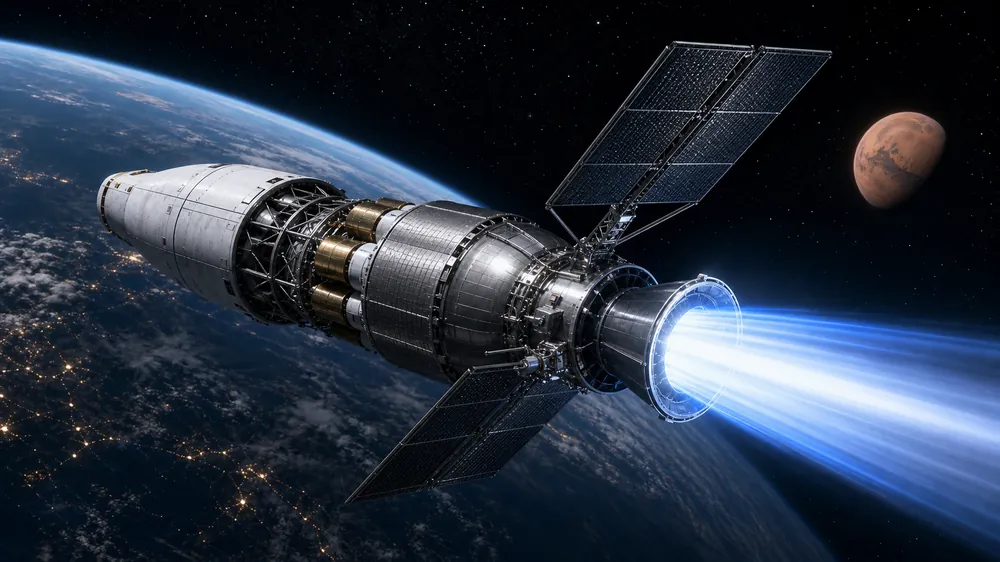
NASA and DARPA are working on DRACO, a program to demonstrate nuclear thermal rocket technology in space. The engine idea is not to explode nuclear fuel. It uses a reactor as a powerful heater. A light propellant, usually hydrogen, gets extremely hot and shoots out of the nozzle to push the spacecraft forward.
The Real Science
A normal rocket burns fuel and oxidizer together. A nuclear thermal rocket uses fission heat to warm propellant directly. Because the propellant can leave the engine very fast, the rocket can be more efficient than many chemical systems. For Mars travel, higher efficiency could help reduce travel time, radiation exposure, and mission pressure.
What Must Go Right
Mind-Blown Version
Simple Meaning
This technology feels out of this world because it changes the normal limit we accept on Earth. Some of it may take years, and some parts may fail, but the direction is clear: space is becoming a place where humans can build power systems, factories, networks, science tools, and safety systems.