
Python Programming Course
A well-structured Python programming course covers the language from fundamentals to intermediate and advanced topics in a logical sequence, building on ea...
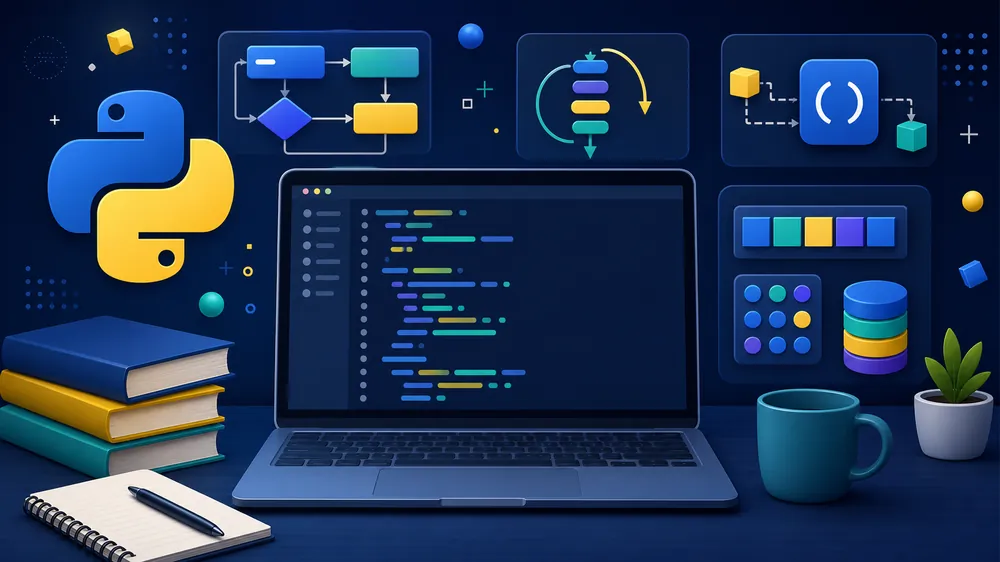
Structured Path Through a Python Programming Course
A well-structured Python programming course covers the language from fundamentals to intermediate and advanced topics in a logical sequence, building on earlier concepts at each stage. Understanding the full curriculum helps you identify which stage you are at and what to study next.
Stage 1 — Python Basics (Week 1-2): Variables, data types (int, float, str, bool), arithmetic operators, string methods, f-strings, input/output, type conversion. Core control flow: if/elif/else, for loops, while loops, break/continue. Functions: defining, calling, parameters, return values, scope.
Stage 2 — Data Structures (Week 3-4): Lists, tuples, sets, and dictionaries in depth. List comprehensions, dictionary comprehensions, and set comprehensions. Nested data structures. Built-in functions: len, sorted, enumerate, zip, range, map, filter.
Stage 3 — Object-Oriented Programming (Week 5-6): Classes, instances, __init__, instance methods, class methods, static methods, inheritance, method overriding, super(), encapsulation, polymorphism, dunder methods (__str__, __repr__, __eq__, __len__).
Stage 4 — Modules and File I/O (Week 7): Importing standard library modules: os, sys, pathlib, json, csv, datetime, re, itertools, functools. Reading and writing files. Working with JSON and CSV data. Writing your own modules and packages.
Stage 5 — Error Handling and Testing (Week 8): try/except/else/finally, raising exceptions, custom exception classes. Writing unit tests with unittest and pytest. Test-driven development basics.
Stage 6 — Advanced Python (Week 9-10): Decorators, generators, context managers, type hints, dataclasses, async/await basics, virtual environments, packaging with pip.
Stage 7 — Applied Projects (Week 11-12): Build 2-3 projects that apply all stages: a CLI tool, a web scraper, a data analysis notebook, or a REST API.
Practical tip: Code along with every lesson. Reading about Python is not the same as writing Python. Set up a Python environment on day one and solve one small problem per day, even if it is just 10 minutes.
Exam tip: Employers care about your projects more than your course certificates. Build a portfolio of 3-5 GitHub projects that solve real problems. Each project should include a clear README, working code, and ideally tests.